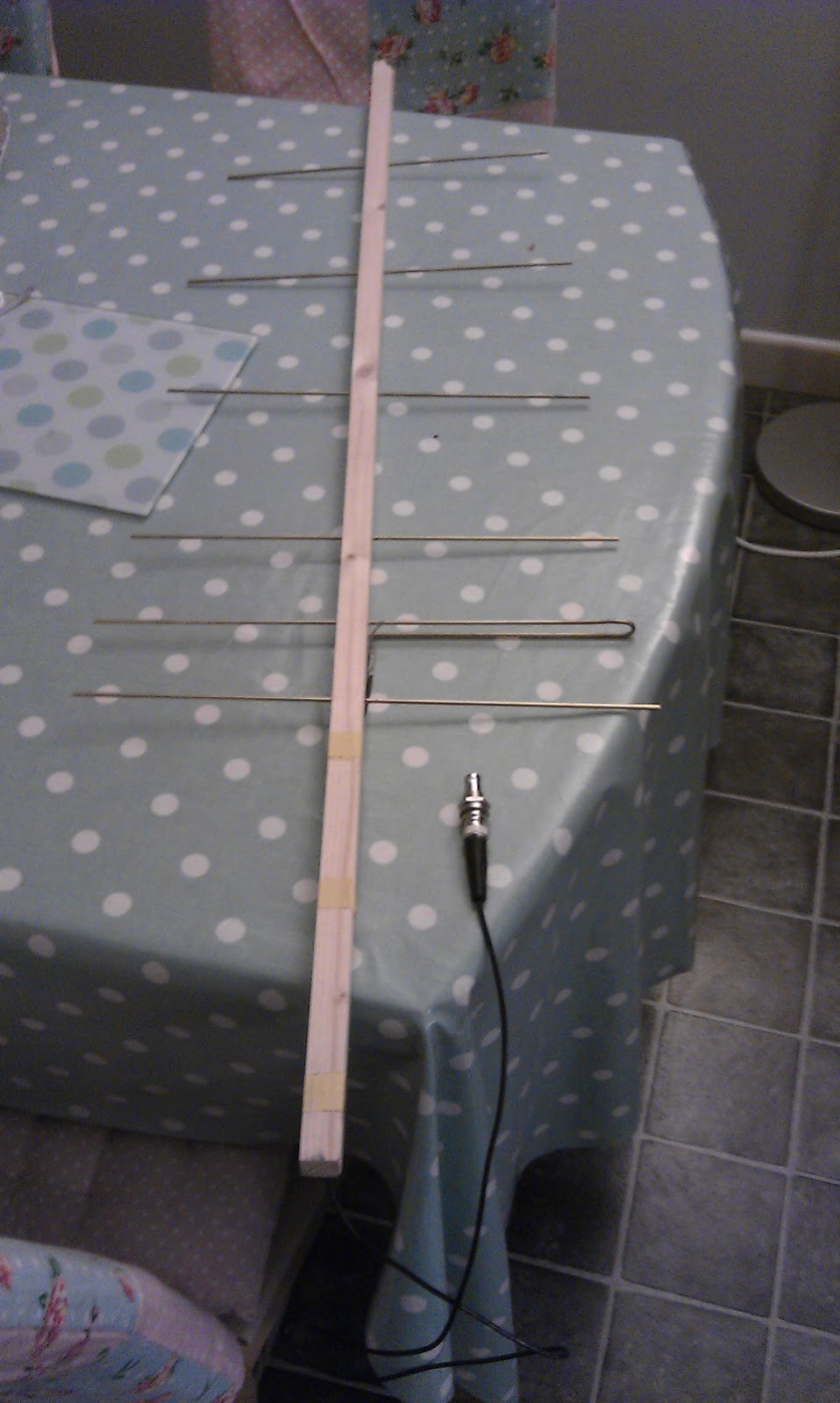
Had a go at making a YAGI:
its 3' long & the soldering on the element will need doing properly
The bars are not glued in yet either, but it does have a female BNC connector on the end
Saturday, 23 March 2013
Tuesday, 19 March 2013
Auto pictures from camera
The Canon powershot A490 turned up & I managed to get the hack kit onto the SD card.
There is a standard script for automatically taking photos after a set time period, so I tried it looking out of the back window:
(must be pretty near the top of the 'most boring video' stakes!)
There were just under 500 pictures taken over 4 hours, at 1 shot / 30 sec, before the batteries ran out. This was all with the screen on (I've not managed to get the script to turn it off yet) so should last for a 5 hour balloon flight.
There is a standard script for automatically taking photos after a set time period, so I tried it looking out of the back window:
(must be pretty near the top of the 'most boring video' stakes!)
There were just under 500 pictures taken over 4 hours, at 1 shot / 30 sec, before the batteries ran out. This was all with the screen on (I've not managed to get the script to turn it off yet) so should last for a 5 hour balloon flight.
Tuesday, 12 March 2013
Cameras
Asked around to see if anyone had a camera they didnt want any more.
Someone found this for us:
Its a 2Mp camera from a good while ago, with only a few drawbacks...
it doesnt seem to work & it weighs about 650g. Might take it apart and see if there is anything useful we can harvest from it.
Looking at another balloon website, it was talking about the Canon A490 :
Only weighs 170g
& I see that it is one of the Canon cameras that you can hack with the Canon Hack Development Kit
http://chdk.wikia.com/wiki/CHDK
Seems you can program things like time lapse or 1 photo every 30 sec, just by adding a script to the cameras SD card
So I ordered one from ebay :)
Someone found this for us:
Its a 2Mp camera from a good while ago, with only a few drawbacks...
it doesnt seem to work & it weighs about 650g. Might take it apart and see if there is anything useful we can harvest from it.
Looking at another balloon website, it was talking about the Canon A490 :
Only weighs 170g
& I see that it is one of the Canon cameras that you can hack with the Canon Hack Development Kit
http://chdk.wikia.com/wiki/CHDK
Seems you can program things like time lapse or 1 photo every 30 sec, just by adding a script to the cameras SD card
So I ordered one from ebay :)
Saturday, 9 March 2013
Collecting temperature & pressure
Got a small board measuring pressure and temperature:
the PCBs are (L to R)
temp/press/altitude monitor
GPS
microSD card board
compass unit (not much good)
Arduino sketch for the temp/pressure chip works fine, sketch for GPS works fine, but I'm struggling to merge them so that it can log both
Then, might be worth logging everything to SD card as well as sending the data to be transmitted
the PCBs are (L to R)
temp/press/altitude monitor
GPS
microSD card board
compass unit (not much good)
Arduino sketch for the temp/pressure chip works fine, sketch for GPS works fine, but I'm struggling to merge them so that it can log both
Then, might be worth logging everything to SD card as well as sending the data to be transmitted
Thursday, 7 March 2013
Insulation
Found this polystyrene box at work
It's probably a bit big for what we need, but it's nice and thick.
Unfortunately, I weighed it & it's a fraction under 300g - I think we are going to have to be careful of our all up weight!
It's probably a bit big for what we need, but it's nice and thick.
Unfortunately, I weighed it & it's a fraction under 300g - I think we are going to have to be careful of our all up weight!
Wednesday, 6 March 2013
RAMFly can sing ....
Well actually, more like tweet (like a bird, not like a teenager...)
I spent way too long again last night, but eventually I got a basic radio telemetry setup working. I can now transmit information a massive 1.5m across my desk. That's without antenna and other required things which should boost the range to many Km.
Here you can see my receiver collecting strings from the RFM22B. The second line has a receive fault (but the spelling mistake is all mine ... :) This was at 50 bps, 100+ proves very unreliable. However, remember there are no antenna though. The blue/yellow band at the bottom of the image is called the 'waterfall' and allows you to visualise non visual energy. Yellow/Red indicates energy and the darker parts silence. You can see here a 1200Hz sound and 1675 Hz sound. These are the sounds produced by the SDR radio in response to frequency shifts and corresponding Upper Side Band (USB) frequency compared with the reference frequency. The better the transmission the brighter/narrower the yellow/red bands will be. Although you can't see very well, there are two vertical red lines (directly beneath the red scale markers). These have to be very precisely aligned with the yellow/red waterfall marks to indicate the two frequencies produced by the payload. The horizontal blue band is the gap between two transmissions.
Wanna hear ramfly sing?
The good chaps on freenode #highaltitude were very helpful. I was labouring under a misapprehension about how to set up dl-fldigi for a couple of hours - very frustrating
I spent way too long again last night, but eventually I got a basic radio telemetry setup working. I can now transmit information a massive 1.5m across my desk. That's without antenna and other required things which should boost the range to many Km.
![]() |
| Ramfly transmitting dummy data across my bench - click to expand |
Wanna hear ramfly sing?
The good chaps on freenode #highaltitude were very helpful. I was labouring under a misapprehension about how to set up dl-fldigi for a couple of hours - very frustrating
Tuesday, 5 March 2013
SDR
Well, that was harder than it ought to have been... Finally got the SDR working on my PC and (almost) on my laptop. The first problem was getting the SDR software, SDR#, to talk to the DVB-T dongle. Despite this being one of the approved ones, it still didn't want to play ball. Depending on where you look, there are a range of different recommended drivers...
Then it was extremely difficult to find a suitable variant (ahem) of the s/w needed to link the output of the SDR radio to the input of dl-fldigi. However, 4 hours later, I am now listening to Radio 1 on the most elaborate radio set-up you're likely to encounter... :)
Time for bed I think...
Then it was extremely difficult to find a suitable variant (ahem) of the s/w needed to link the output of the SDR radio to the input of dl-fldigi. However, 4 hours later, I am now listening to Radio 1 on the most elaborate radio set-up you're likely to encounter... :)
Time for bed I think...
Subscribe to:
Posts (Atom)


